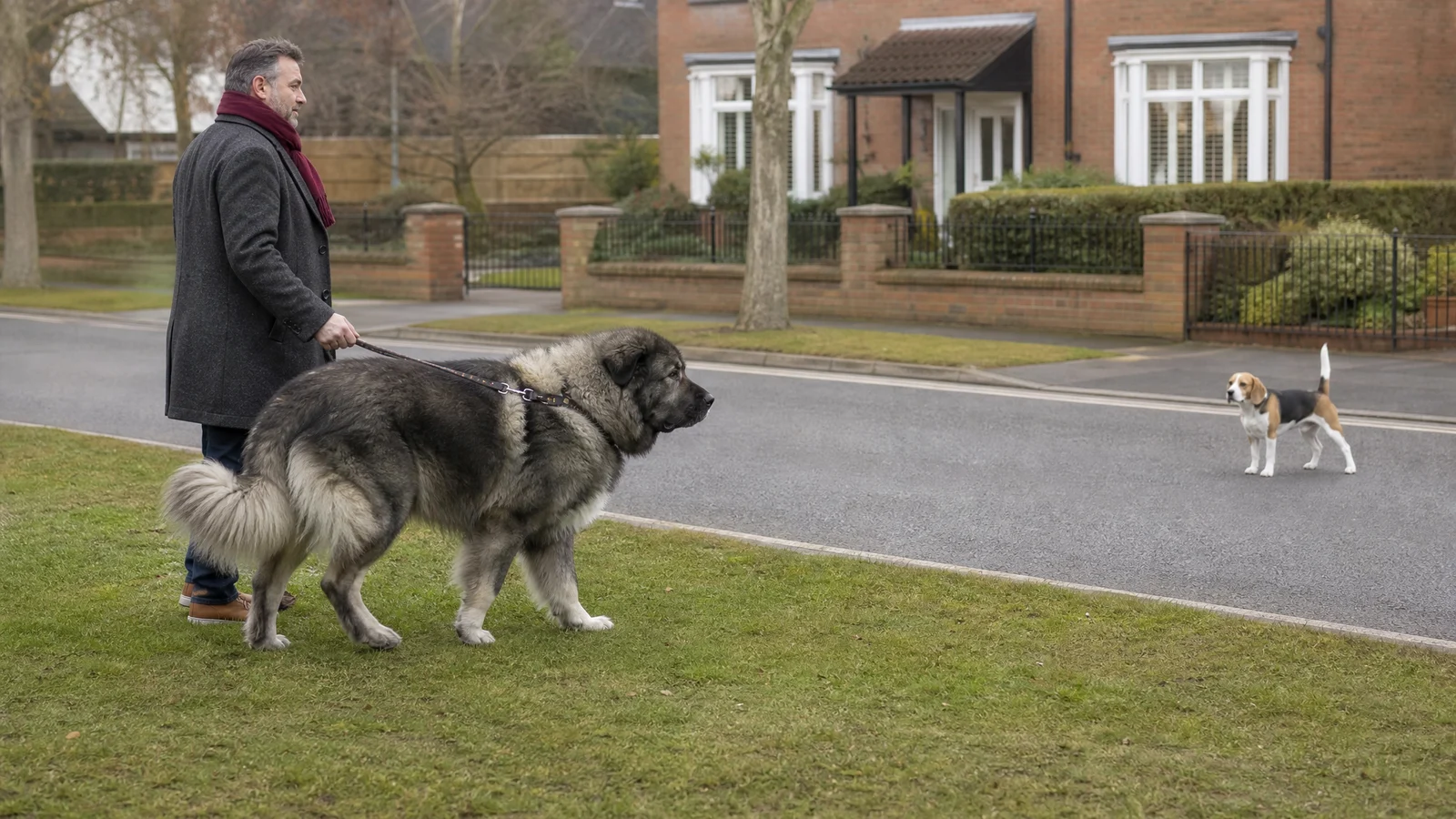
The walk has been easy so far, a loose leash and a slow rhythm, when another dog steps out across the street. Your Caucasian Shepherd Dog goes rigid, the leash turns heavy, and the relaxed stroll of a moment ago becomes a stillness that is easy to mistake for calm. There may be no bark and no lunge at all, only a lifted head and a body that has stopped moving.
What is happening is a guardian breed judging an unfamiliar dog, which has nothing to do with stubbornness. Handled badly, that judgment hardens into lunging and walks that shrink to the emptiest streets in town. Handled well, it gives you a steady giant who notices everything and still stays beside you.
This guide covers the limits of gentler-guardian advice, the shift from puppy squabbles to adult stakes, and the distance that keeps fence and street encounters safer.
Caucasian Shepherd Dog Aggression Versus a Great Pyrenees
Big, thick-coated guardian breeds tend to be grouped together, so advice written for a gentler look-alike such as the Great Pyrenees gets passed along as if it suits every flock guardian. It does not carry over.
The breed standard describes an active defense reaction and strong territorial instincts that make the Caucasian very suspicious of strange people or dogs. That suspicion is simply the Caucasian behaving as they were designed to, and it is no sign that your training has a hole in it.
The ratings point the same way. This is described as a serious guardian breed that should never be taken lightly, with the top score for watchdog and protective nature and a low score for openness to strangers. A dog like that does not shrug at a passing dog and carry on. Tips that seem to work on softer guardians, such as letting dogs say hello and trusting them to settle, can turn a mild reaction into a serious one very quickly.
Begin from a different assumption instead. Your dog will notice every unfamiliar dog, will care about it, and needs room plus your steady guidance to conclude that nothing is required of them. Test any tip borrowed from another guardian breed against what your own dog actually does before you rely on it, and our overview of dog aggression in Caucasian Shepherds shows how the pieces fit together.
Puppy Squabbles Differ From Adult Caucasian Shepherd Dog Aggression
A Caucasian Shepherd puppy who bristles at a visiting dog looks almost comical, a fluffy bundle growling at something far larger than themselves, and the episode is usually forgotten within minutes. The same posture in an adult carries a different weight, because the dog on the receiving end is dealing with real size and real strength.
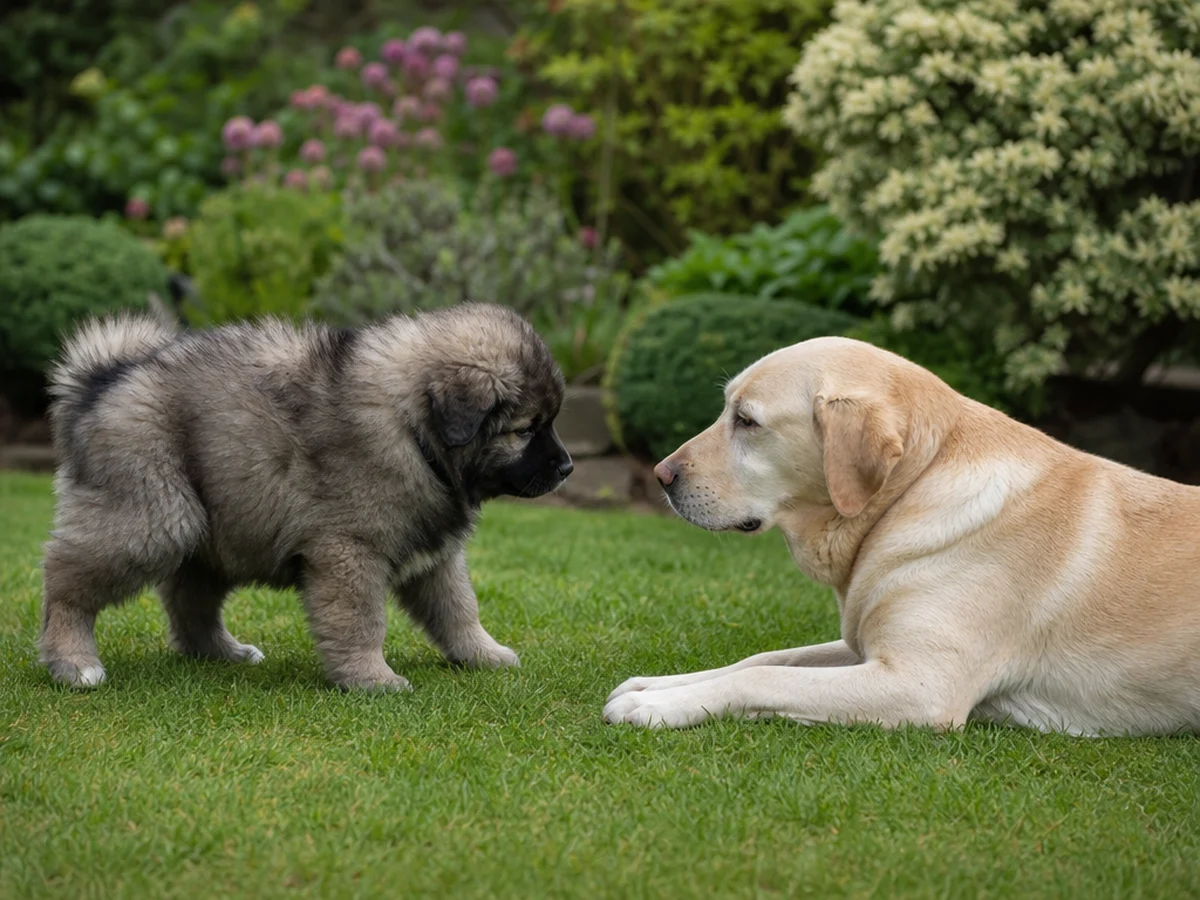
With a rating of 2 of 5 for getting along with other dogs, the breed is telling you that the adult is where the difficulty shows, so the puppy months are your chance to build habits while the stakes are still small.
When Rough Play Stops Being Play
Healthy puppy play has give and take, with pauses, role swaps and loose, bouncy bodies. It stops being play when a puppy goes silent and stiff, fixes a hard stare, or keeps pressing after the other dog has tried to leave. Step in calmly by ending the session and letting everyone settle, rather than hoping it sorts itself out, and reward the puppy for coming away to you.
How Size Raises the Stakes
The breed is slow to mature and headstrong, and social maturity arrives somewhere between 12 and 36 months, the same stretch when aggression and anxiety problems tend to develop. An easygoing puppy can become a wary adolescent and then a stiff, watchful adult, so early socializing is a foundation and never a finished job.
Short meetings with steady adult dogs you know, parallel walks at a comfortable gap, and treats for simply watching dogs from afar all build the right habits. Our guide to welcoming visitors and other dogs covers setups in more detail.
Chosen Distance Beats Forced Greetings for Dog Aggression
The most common advice for dogs meeting dogs is to let them sniff and sort it out, which suits an animal who treats every newcomer as a potential friend. For a Caucasian Shepherd, a nose-to-nose greeting on a short leash is closer to a trap.
A dog who feels cornered can turn aggressive, and a tight leash on a narrow sidewalk with a stranger approaching creates exactly that feeling. Pulling your dog in for an introduction also teaches them that you will not manage the space on their behalf.
Distance does the opposite. Every dog has a point where another dog is noticed but clear thinking is still possible, and the notice-and-move-away method works from there.
You move toward the other dog just far enough that yours registers them without reacting, then turn away and reward with praise, toys or treats, repeating before any reaction begins. Having spent many years living and working with this breed, we find the same logic holds on ordinary daily walks, where no helper dog is needed.
A dog who is far enough away can look, process and look back at you, and that glance back is the behavior worth paying for. Leaving early is not retreat, it is how you keep your dog thinking. The order of the steps matters:
- Scan ahead at every corner, gate and driveway so you see the other dog before your dog does.
- Turn the moment your dog's head and ears lock on, which comes before the body stiffens.
- Walk a wide arc or a relaxed U-turn at an ordinary pace, dropping treats as you go.
- Keep moving until the body softens and your dog takes food easily again.
- Note where the line fell today and start tomorrow's walk a little outside it.
Progress comes from that gap shrinking slowly over weeks, never from a greeting used as a test. Keep the distance generous.
Rewarding Calm Beats Punishing a Guardian's Growl
A growl is a message, and from a guardian this size it is information you want to keep receiving. If a dog learns that warning makes their owner tense and angry, they may stop warning, and you are left with a large dog who goes from silent to explosive with nothing in between. Keeping the warning visible is worth more than any short-term quiet, and our piece on Caucasian Shepherd warning growls and alertness helps you read what each one means.
The better trade is to pay for the calm moments. When another dog appears and yours glances at them without stiffening, say your marker once, then deliver the treat. When they turn their head away on their own, mark that too and pay more generously, since looking away is a decision and you want it to be the most profitable choice available. Over many repetitions, a dog in the distance becomes a cue to check in with you.
If a growl does come, treat it as a request for more space, then turn calmly and walk off with a cheerful voice. Change takes patience, because counter-conditioning works but is no instant fix and must follow your dog's pace, while management between sessions protects the progress. The breed is extremely independent and can be hard to train for obedience, though not impossible, so keep sessions short and the treats excellent.
Normal Caucasian Shepherd Dog Aggression Versus Lost Control
The breed standard says mild dog aggression is a normal characteristic and is not to be penalized, and in the same passage it says handlers may be penalized for failing to control their dogs. Put together, those statements draw a clear line, with the wariness belonging to the dog and the control belonging to you. Normal dislike looks like a dog who notices, stiffens, perhaps growls or barks, and still responds when you calmly create space and call them away.
Lost control looks different, and these signs mean the plan must change before the next outing. Treat them as firm thresholds:
- Your dog no longer hears your voice and drags you toward the other dog.
- Food is refused entirely, even high-value treats.
- The stare stays locked long after the other dog has gone.
- Reactions grow sharper or start at a greater distance than last week.
At that point the question is less whether the dog is difficult and more whether the situation asked too much of both of you. What you owe a dog of this size is a plan, meaning secure fencing, leashed walks, gear you can handle with both hands, early exits and honest limits on where they go.
The same standard notes that socialization and patient training can temper the breed's suspicion, leaving a grown dog with sound judgment. If tolerance suddenly drops, bring it up at your regular veterinary visits, since discomfort can shorten any dog's patience.
Fence-Line Dog Aggression Differs From Street Encounters
Not every reaction to another dog is the same behavior. A Caucasian Shepherd at their own fence is defending ground, while the same dog on a leash in public is facing a stranger they cannot walk away from, and each situation needs its own management.
At the Fence
The breed has strong territorial instincts and keen senses, so any change in the surroundings can bring warning barks and growls, particularly at night, and a fence line gives that instinct a stage. A dog who patrols the boundary and performs for every passing dog is rehearsing the very habit you want to fade.
Keep the yard secure, limit unsupervised time along busy boundaries, and block the view along the worst stretches with a solid screen. Reward your dog for turning away from the fence and coming to you, and see our guide to Caucasian Shepherd night barking for the after-dark side.
On the Street
On a leash, your dog cannot retreat, and when a fearful dog ends up cornered or trapped, aggression becomes more likely, so you must provide the escape for them. Keep walks leashed and choose routes with room to turn, such as wide sidewalks, driveways to step into, and parked cars or hedges that break the line of sight.
When a surprise does arrive, such as a loose dog or an opening gate, put something solid between the dogs, scatter treats on the ground so the nose goes down, and ask the other person early to leash their dog.
Start Today by Measuring Your Caucasian Shepherd Dog's Distance
Everything above comes down to one number you can find on your next walk, the distance at which your dog sees another dog and stays relaxed. Head out with plenty of excellent treats and a secure leash, and when another dog appears, watch your own dog instead of the stranger.
A loose body, a taken treat and a glance back to you mean you are standing in the right place. A stiff stance, a fixed stare or refused food means you are too close, so turn and add space until the softness returns.
Note roughly where that spot was, and pay for calm at that gap for several days before narrowing it by small steps. If you are unsure, start farther away than feels necessary, because a dog who stays comfortable learns far more than one who barely holds together.
This breed will always have opinions about strange dogs, and your job is to make sure they never feel they must act on those opinions alone. Stay under their limit, leave before trouble starts, and let them learn that the best thing in the neighborhood is the person holding the leash.
 BehaviorQuieter Nights for a Caucasian Shepherd Who Barks at Every Sound
 Training basicsStop Pulling and Lunging When Walking a Caucasian Shepherd
 Training basicsStrong-Willed and Smart: Training a Caucasian Shepherd