

A common trap is going out to check on the dog or opening the door to let them patrol after a nighttime sound. Either way the alarm can get paid, with attention or with a lap of the territory, and a behavior that pays tends to be repeated, so the next sound may earn a bigger response. The drive behind territorial barking stays in place until the dog has a better plan to follow.
The fix comes before any training. Manage where your Caucasian Shepherd Dog sleeps and what they can see and hear, then teach a routine of acknowledging a sound and settling on a bed. The breed standard describes keen senses and warning barks at night, so we treat darkness as their natural working hours and not a flaw to erase.
This guide looks at barking at night in four kinds of homes: a thin-walled apartment, a house with children, a pair of dogs, and an owner who spends the workday out. It closes with a two-week practice plan.
Apartment Barking at Night With a Caucasian Shepherd Dog
Apartments multiply the triggers. Footsteps in the hallway, an elevator, a neighbor's door, and headlights sweeping across a window are all changes in the surroundings, and changes are what set off warning barks and growls in this breed. Breed profiles rate barking low overall, 2 of 5, yet rate the watchdog and protective nature at the top, 5 of 5. That pairing fits the dog you probably have: quiet indoors by day, serious about every new sound after dark.
Because building noise is frequent and unpredictable, you cannot train your way through all of it at once. Start with management, which lowers how many alerts reach the dog, and then add a routine for the ones that still get through.
The Sleeping Spot
Choose a spot away from the front door, shared walls, and windows, ideally in or beside your bedroom so you can reward quiet without crossing the apartment. A dog who sleeps near the entry hears each footstep at close range, and a dog who sleeps near a window sees each passing light. Both end up with the alarm triggered closer than it needs to be.
Make the bed a place the dog already likes before you rely on it. Drop treats there during the day and let them nap there with no demands. A bed they have chosen is much easier to send them to at 2 a.m. than one that only appears when trouble starts.
The Sounds
You cannot silence a building, but you can soften it. A fan or steady white noise machine at modest volume, placed between the bed and the door, lets a single footstep land on background hum instead of on silence. A rolled towel at the bottom of the front door cuts some hallway noise and the moving shadows that slip under it.
Cover the windows as well, with blinds or frosted film. A dog who watches the street by day is rehearsing the alarm for hours, and that practice likely carries into the night. Masking sound and blocking views will not teach anything on their own, but they give the training a fair start.
Acknowledge, Then Settle
Teach the routine in small rewarded steps: decide on the final behavior, then build it piece by piece. Here the final behavior is one or two alert barks, a calm word from you, and a walk to the bed. A marker word such as yes, said just as paws touch the bed and followed by a treat, shows your dog precisely which action paid off.
- During the day, mark each time the dog steps onto the bed and place a treat there, until they head over on their own.
- Add a cue such as settle just before they lie down, and reward calm lying down with several treats in a row.
- Play a recording of hallway sounds at low volume while the dog is on the bed, and reward quiet before any bark can happen. Raise the volume only over many sessions.
- At night, when a real sound brings one or two barks, say a calm thank you, then call the dog to bed in a friendly, upbeat voice and reward them there.
- Reward quiet in the gaps afterward, then stretch the time between treats slowly.
Allowing those first barks is deliberate. The dog has done their job, and you are paying for what comes after it. If the barking runs on, make the setup easier by lowering the sound level or adding distance, rather than asking for more than the dog can give that night.
Why Bark at Night With Young Kids?
A house with children produces a stream of nighttime sound that means something to a family guardian: bath water, a child calling from bed, a bathroom trip, a friend sleeping over, a parent's quick footsteps.
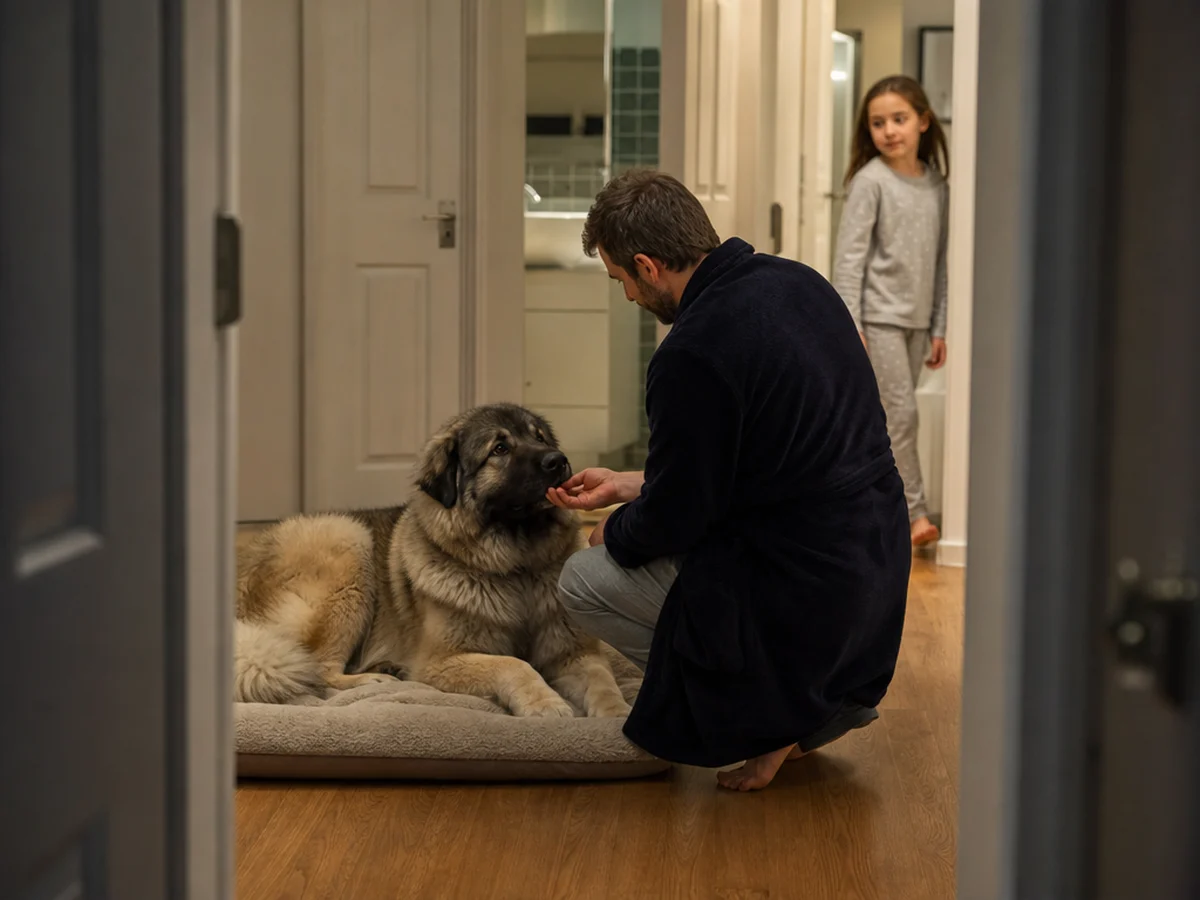
This breed is gentle with family but highly protective of them, and profiles rate them at 3 of 5 with young children, which means with supervision. Our best reading, and it is a reading rather than a proven mechanism, is that a child's cry or an unfamiliar guest can look like danger to a dog who takes the family's safety seriously.
Sort the Sounds First
Real alerts and routine sounds need different responses, so sort them before you train anything. The categories lead to different plans.
- Routine sounds happen on a schedule, like the bath and the last bathroom trip. Pair them with a treat on the dog's bed before any barking starts and they soon become boring.
- Unexpected sounds from inside, like a child calling out, call for a parent to go to the child while the dog is cued to their bed and rewarded for staying there.
- Sounds from outside, like a car door or someone at the gate, are the genuine alerts this breed was made to notice. Allow one or two barks, then use the acknowledge and settle routine.
- Sleepover guests need a plan ahead of time, with the dog behind a closed door or gate in their own area, since this breed is very suspicious of strangers.
Keep the Dog Away From the Children's Rooms
Put the dog's bed near the adults and out of sight of the children's doors. A dog stationed outside a child's room has a spot to defend and hears every rustle inside, while a dog sleeping near the adults can be settled and rewarded by a parent within seconds. A gate or closed door makes this simple and costs nothing in affection.
Children should not run to the dog or shush them in the night, because excited attention is the very reward you are trying to remove. Let the kids say a quiet goodnight at bedtime and leave the night shift to the adults. Reward the dog for calm while the children settle, so bedtime noise predicts treats instead of danger.
Why Do Two Dogs Bark at Night?
In a two-dog home, the first bark is often not the whole problem. One dog sounds an alarm, the second hears it and joins in, and soon each dog's barking sets off the other. The second dog may never have noticed the original sound at all. Breed profiles also rate the Caucasian Shepherd Dog 2 of 5 on how well they do with other dogs, which means some pairs need extra care around each other in general.
Separate the Pair
Sleep each dog in a separate area, out of sight, behind a solid barrier such as a closed door. Distance cuts the chain because the follower loses the visual signal, even if the two can still hear each other at first. Note which dog usually starts, since that dog gets the first rounds of the acknowledge and settle routine.
If tension between your dogs reaches past noise, our guides on dog aggression in Caucasian Shepherds and managing dislike of strange dogs cover what to do next. Start with safe separation.
Reward Each Dog Alone
Practice by day with one dog on their bed while the other is elsewhere, and reward quiet as a recorded sound plays. Each dog is paid for their own calm, so neither dog's slip costs the other a treat. Treat the follower as a separate project, because they need to learn that another dog's bark is not their cue.
Once each dog settles well alone, bring the beds closer a little at a time, rewarding the follower for silence whenever the starter gives one or two barks. Change one thing per night, and go back a step if the chain returns.
A Workday's Effect on Caucasian Shepherd Dog Barking at Night
It may, though this is our reasoning rather than a measured result. A dog left alone with nothing to do tends to doze through long hours, and a well-rested watchman has the most energy for alarms when the household finally relaxes in the evening. The breed is described as low energy with good endurance for walking, and mental stimulation needs sit at 3 of 5. So aim for a dog who is calmly satisfied by bedtime, not one who is wound up.
Daytime Rest and Sight Lines
Where the dog rests by day matters. If their favorite nap spot looks onto a street or gate, they spend hours rehearsing alarm at every passerby. Give them a bed in a room with no view, and use window film or a closed door to the front room.
A chew or food puzzle left for the hours you are out gives the mind something moderate to do. If being alone is itself hard for your dog, teaching calm time alone deserves its own attention, since a dog who struggles by day can arrive at the evening unsettled.
A Settled Evening
Let the evening run downhill. Give a leashed walk soon after you get home, or time in a secure fenced yard, because this breed should be contained whenever they exercise. Follow it with dinner, a chew on the bed, and quiet household activity instead of tug or wrestling games that wake the guardian up.
Then keep bedtime identical each night: a last short trip outdoors, a treat on the bed, lights off. A predictable ending gives a watchful dog fewer reasons to stay on duty.
Choosing a Night-Barking Setup
Match the first change to the household rather than running every dog through the same calendar. Hold the other conditions steady for several nights, record the first bark and the recovery time, and keep the change that produces a shorter, easier return to bed.
| Household | First change | Useful progress |
|---|---|---|
| Apartment | Place the bed against an interior wall and soften hallway noise | Fewer bark chains after doors or footsteps |
| Young children | Gate the sleeping area away from children's rooms | The dog settles while an adult handles a night interruption |
| Two dogs | Use separate sleeping areas and reward each dog alone | One dog's alert no longer starts the other |
| Long workday | Add daytime walking and remove the street view from the rest spot | The first alert comes later and recovery is faster |
Progress is not perfect silence. Look for fewer barks per sound, a faster return to the bed and a dog who checks in after the first alert. A sudden change in a previously quiet adult belongs on the list for the next regular veterinary visit.
A Caucasian Shepherd Dog will remain a watchman. The practical goal is an alarm that ends when the household is safe, with a setup chosen for the home the dog actually lives in.
 Training basicsStop Pulling and Lunging When Walking a Caucasian Shepherd
 Training basicsStrong-Willed and Smart: Training a Caucasian Shepherd
 BehaviorIs My Caucasian Shepherd Angry or Just Alert?